Technical Specification for Tensile, Compression, and Bending Specimen Test Molds
Material mechanical property testing is a critical link in industrial production to verify material applicability. Tensile, compression, and bending specimen test molds correspond to the detection of core indicators such as material tensile strength, compressive strength, and flexural modulus respectively. These three types of molds must strictly comply with industry standards including GB/T 1040 (tensile), GB/T 1041 (compression), and GB/T 9341 (bending) to ensure uniform force on specimens and repeatable test results. Mold design should adapt to different material characteristics (e.g., metals, plastics, composite materials), balance machining accuracy and service life, and meet the efficient testing needs in mass production.
I. Tensile Specimen Test Mold
1. Structure Composition
The core structure consists of upper chuck, lower chuck, positioning device, and guiding mechanism. The upper chuck adopts a wedge-shaped clamping structure, while the lower chuck is rigidly connected to the tensile testing machine table. The positioning device ensures the coaxiality error between the specimen's central axis and the force direction is ≤0.5%. The guiding mechanism uses rolling guides with a friction coefficient ≤0.015 to ensure smooth and non-sticking movement of the chuck. The mold body is made of 40CrNiMoA alloy structural steel, hardened and tempered to a hardness of HRC 38-42. The contact surface of the chuck is nitrided to achieve a surface hardness ≥HRC 60, enhancing wear resistance.
2. Key Technical Parameters
Adaptable specimen types: Dumbbell-shaped (Type Ⅰ, Type Ⅱ), rectangular cross-section specimens; thickness range 0.5-10mm, width 10-50mm;
Clamping force adjustment range: 5-50kN, hydraulically driven with pressure fluctuation ≤±1%;
Chuck opening: 0-60mm, adjustment accuracy 0.01mm;
Operating temperature range: -40℃-200℃, with ceramic coating for anti-adhesion in high-temperature environments.
3. Application Scenarios and Technical Trends
Mainly used for testing tensile strength and elongation at break of metal sheets, plastic films, composite materials, etc., widely applied in automotive, electronics, aerospace and other industries. The current technical trend focuses on intelligent upgrading. Some molds integrate pressure sensors and displacement monitoring modules to real-time feedback clamping status, avoiding specimen slipping or damage. Meanwhile, modular design enables quick chuck replacement to adapt to different standard specimens, improving testing efficiency.
II. Compression Specimen Test Mold
1. Structure Composition
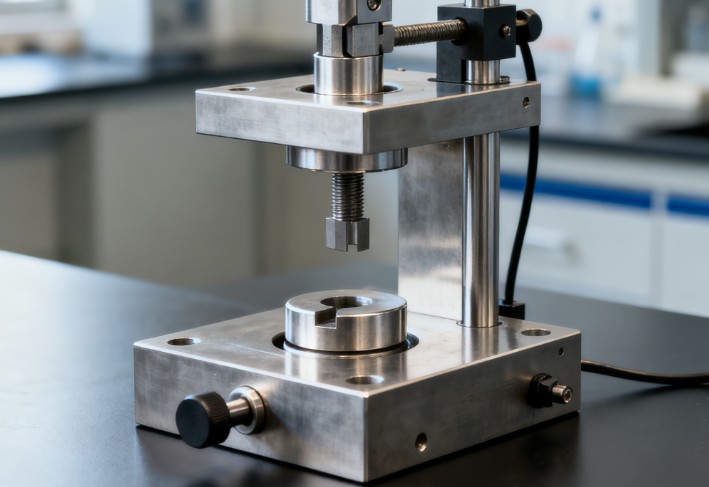
Comprises upper indenter, lower indenter, limiting device, and centering mechanism. The indenter adopts a circular or square structure with a contact surface roughness Ra≤0.8μm to prevent specimen damage. The centering mechanism achieves automatic centering through bidirectional guides with a centering accuracy ≤0.1mm. The limiting device can adjust the compression stroke (maximum stroke ≥100mm) to prevent mold damage caused by excessive specimen compression. The mold base is integrally cast with HT250 cast iron to ensure rigidity and reduce deformation during testing.
2. Key Technical Parameters
Adaptable specimen sizes: Cylindrical (diameter 10-50mm, height 20-100mm), cubic (side length 10-50mm);
Maximum bearing pressure: ≤2000kN, pressure measurement accuracy ±0.5% FS;
Indenter parallelism: ≤0.02mm/m;
Compression rate adaptation range: 0.1-50mm/min, synchronized with testing machine control.
3. Application Scenarios and Technical Trends
Suitable for testing compressive strength and elastic modulus of concrete, rubber, foam materials, etc., serving as core testing equipment in construction, building materials, packaging industries. The technical development direction focuses on anti-instability design and data linkage. Lateral support devices are added to the indenter to solve the instability problem of slender specimens during compression. It also supports seamless connection with testing software to automatically record compression curves and peak data, realizing digital traceability of the testing process.
III. Bending Specimen Test Mold
1. Structure Composition
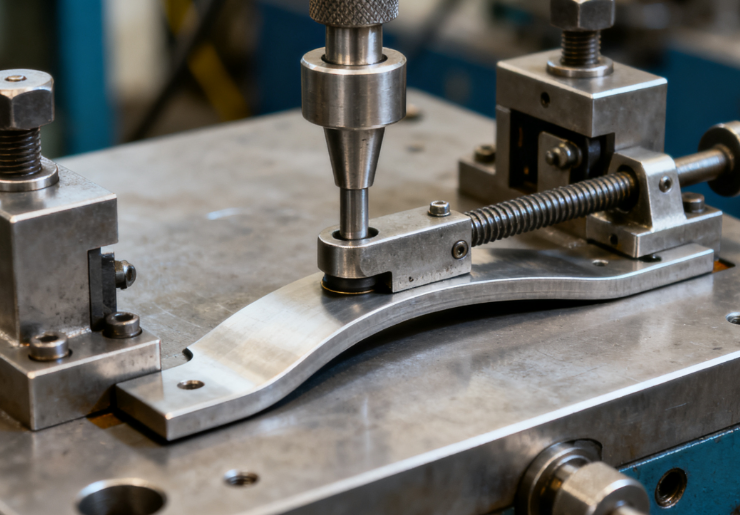
Consists of supports, indenter, span adjustment mechanism, and anti-warping device. The supports adopt a double-roller structure with a roller diameter of 10-20mm, quenched to a hardness of HRC 55-60. The indenter is cylindrical, with a diameter ratio to the support roller diameter meeting standard requirements (usually 1:1 or 2:1). The span adjustment mechanism uses ball screw transmission, with an adjustment range of 50-300mm and an adjustment accuracy of 0.1mm. The anti-warping device fixes the two ends of the specimen with elastic pressure plates to prevent vertical movement during bending.
2. Key Technical Parameters
Adaptable specimen sizes: Rectangular cross-section (thickness 2-20mm, width 10-50mm, length 100-400mm);
Maximum bending force: ≤500kN, force measurement accuracy ±0.5% FS;
Indenter pressing speed: 0.5-30mm/min, uniformity error ≤±2%;
Adjustable span step: 1mm, meeting the requirements of different standards for span-thickness ratio (usually 16:1, 32:1).
3. Application Scenarios and Technical Trends
Mainly used for testing bending strength and deflection of metal profiles, plastic sheets, wood, etc., commonly applied in machinery manufacturing, furniture, rail transit and other industries. The current technical trend emphasizes multi-functional integration and personalized adaptation. Some molds can switch between three-point and four-point bending modes to meet different testing standard requirements. Meanwhile, wear-resistant polymer materials are used for contact components to reduce damage to brittle materials and improve the accuracy of test data.
IV. General Mold Maintenance and Precautions
1. Daily Maintenance
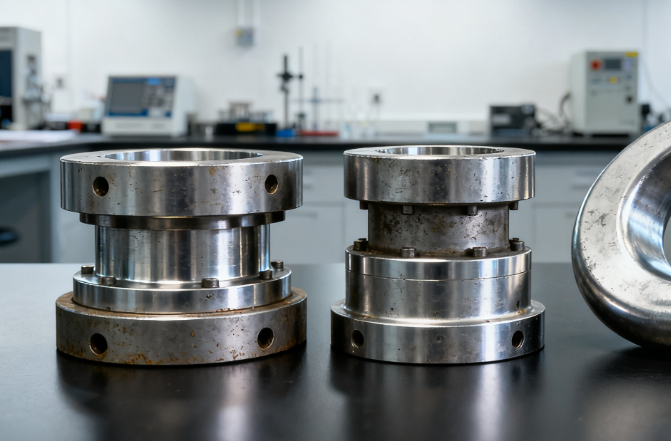
Regularly clean the mold contact surfaces to remove residual specimen debris and oil; inspect the lubrication of the guiding mechanism monthly and add high-temperature grease; calibrate key parameters such as chuck parallelism and centering accuracy quarterly.
2. Safe Operation
Confirm that the mold is firmly installed and the specimen is accurately positioned before testing; avoid over-range and over-temperature use to prevent mold deformation or failure; equip protective devices when operating in high-pressure and high-temperature environments.
3. Service Life Guarantee
Apply anti-rust oil to the mold when idle and store it in a dry and ventilated environment; regularly inspect the wear of vulnerable parts (e.g., chucks, indenters) and replace them in a timely manner when the wear limit is reached (usually surface wear ≥0.2mm).