Professional English Translation of Streamlined Technical Document
Test piece test molds are core tools for material performance testing and product R&D, directly determining the molding precision of test specimens and the reliability of test data. As three fundamental industrial materials, plastics, rubber, and metals correspond to plastic test piece test molds, rubber test piece test molds, and metal test piece test molds respectively. These molds share general mold design principles while featuring distinct professional characteristics due to material property differences. This document systematically elaborates on the core technical points and application specifications of the three types of molds, integrating practical production scenarios and industry technical trends.
I. Plastic Test Piece Test Molds
Plastic test piece test molds are mainly used to produce standard test specimens for tensile, bending, and impact tests, suitable for general-purpose and engineering plastics such as PP, ABS, PC, and PA.
1. Core Structural Design Points
Cavity structure: Adopts single-cavity or multi-cavity modular design, with 2-4 symmetric cavities for multi-cavity molds to ensure uniform melt flow. The cavity surface undergoes mirror polishing (Ra ≤ 0.8μm) to avoid surface defects affecting tensile test results.
Gating system: Cold runner or hot runner design is selected based on plastic fluidity. Hot runner systems are preferred for engineering plastics with poor fluidity to reduce melt retention. Gates are positioned in non-test areas of specimens to prevent stress concentration caused by gate marks.
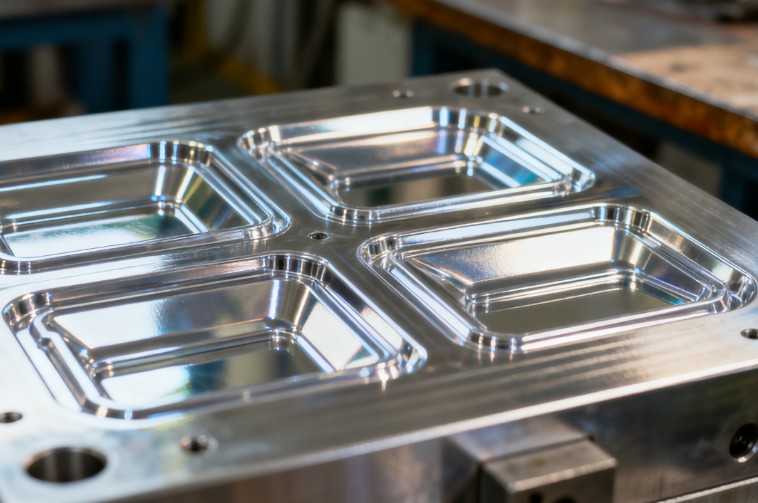
Cooling system: Features uniformly distributed water channels (spacing 15-25mm, distance from cavity wall ≥ 8mm) to control mold temperature fluctuation within ±2℃, avoiding internal stress in specimens due to uneven cooling.
2. Key Technical Parameter Specifications
Dimensional accuracy: Critical cavity dimensions have a tolerance of ±0.02mm (complying with GB/T 1040.2-2006), with parallelism ≤ 0.01mm/m and perpendicularity ≤ 0.015mm/m for geometric tolerances.
Mold material: Core cavity components are made of P20 or S136 steel, quenched and nitrided to HRC 50-55 for wear resistance and service life.
Mold opening/closing performance: Guide pillars and bushings use clearance fit (0.005-0.01mm) for smooth operation without jamming, with a single test cycle of 30-90 seconds (adjusted by plastic type).
3. Production Application and Technical Trends
Application points: Preheat molds (40-120℃) according to plastic properties before testing; control injection pressure at 80-150MPa to avoid specimen flash. Aging test specimens for 48 hours before performance testing.
Technical trends: Integrate intelligent temperature control modules for real-time monitoring and automatic adjustment. Adopt 3D printing for rapid tooling, shortening mold production cycle by 30%-50% for small-batch R&D. Apply nano-coatings on cavity surfaces to enhance demolding performance and corrosion resistance.
II. Rubber Test Piece Test Molds
Rubber test piece test molds are suitable for elastic materials such as natural rubber, nitrile rubber, and silicone rubber, used to produce test specimens for Shore hardness, tensile strength, and compression set tests.
1. Core Structural Design Points
Cavity design: Complies with HG/T 2176-2011, with dumbbell-shaped tensile specimens. 0.1-0.2mm wide vents are set on cavity sidewalls to release vulcanization gas and avoid bubbles.
Clamping mechanism: Uses bolt fastening or hydraulic clamping (clamping force ≥ 5MPa) to prevent rubber flash. Mold parting surfaces have precision fitting with clearance ≤ 0.03mm.
Heating system: Adopts electric heating tubes or hot oil heating, with uniform heating zones and temperature control accuracy of ±3℃, adapting to rubber vulcanization temperature (150-180℃).
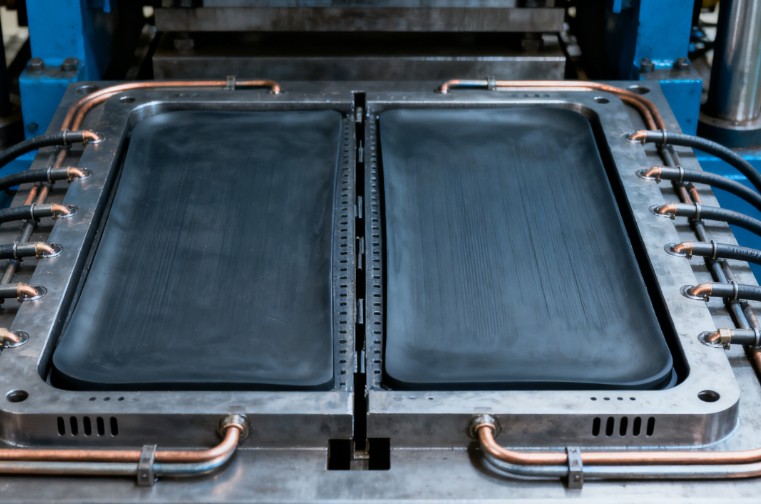
2. Key Technical Parameter Specifications
Mold hardness: Cavity material is Cr12MoV or SKD11, heat-treated to HRC 58-62 for wear resistance and deformation resistance.
Vulcanization adaptation: Mold heat capacity matches vulcanization time (5-20 minutes for conventional rubber specimens), with rapid heating and heat preservation capabilities.
Demolding design: Cavity inner walls have micro-arc transitions to avoid sharp angles. Ejector mechanisms are equipped for some elastomer molds (ejection pressure 0.5-1MPa) to prevent specimen deformation.
3. Production Application and Technical Trends
Application points: Preform rubber materials before vulcanization for uniform filling. Clean residual rubber in cavities after use to avoid carbon deposition affecting subsequent molding.
Technical trends: Replace traditional steel cores with silicone cores to reduce small-batch customization costs. Integrate vulcanization curve monitoring to feedback vulcanization progress in real time. Apply PTFE coatings on mold surfaces to improve demolding efficiency and reduce release agent usage.
III. Metal Test Piece Test Molds
Metal test piece test molds are used to produce tensile, bending, and shear test specimens for metal materials such as steel plates, aluminum alloys, and copper alloys, adapting to stamping, die-casting, and forging processes.
1. Core Structural Design Points
Forming process adaptation: Stamping molds adopt upper and lower die cutting edge matching (clearance 5%-8% of material thickness) to avoid metal tearing. Die-casting molds have reasonable runners and overflow grooves for full metal melt filling.
Mold base structure: Rigid mold base design with deformation ≤ 0.01mm, adapting to high-pressure metal forming (stamping pressure 50-200MPa).
Guide system: Uses rolling guide pillars and bushings with guide accuracy ≤ 0.005mm to ensure precise alignment of upper and lower dies.
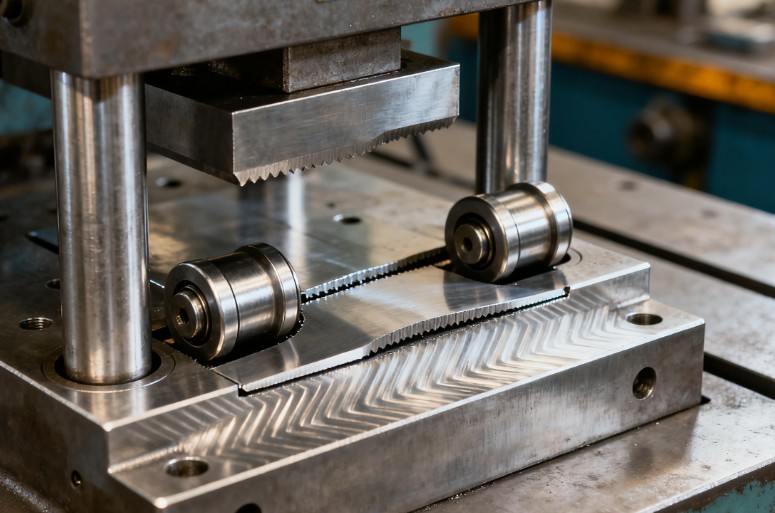
2. Key Technical Parameter Specifications
Mold material: Stamping die cutting edges are Cr12MoV or DC53 (HRC 60-64); die-casting mold cavities are H13 steel with surface hardness ≥ HV800 after nitriding.
Dimensional accuracy: Critical specimen dimensions have a tolerance of ±0.015mm (complying with GB/T 228.1-2010), with surface roughness Ra ≤ 1.6μm and no burrs or scratches.
Wear resistance: Vulnerable parts adopt detachable design for easy replacement. TiN or DLC coatings enhance wear resistance by 3-5 times.
3. Production Application and Technical Trends
Application points: Preprocess metal materials (derusting, oiling) to prevent mold wear and specimen surface defects. Regularly inspect stamping die cutting edge sharpness; regrind when wear exceeds 0.02mm.
Technical trends: Introduce digital twin technology to optimize mold structure and forming parameters via simulation. Use additive manufacturing for complex cavity molds to shorten R&D cycles. Integrate online monitoring modules for real-time feedback on mold stress and wear, enabling predictive maintenance.