Detailed Explanation of Injection Molding Process Parameters for PBT Material Molds
1. PBT Material Properties and Preprocessing Specifications
1.1 Core Material Properties
As a crystalline engineering plastic, PBT (polybutylene terephthalate) offers excellent mechanical strength and heat resistance but is sensitive to processing conditions. Its typical shrinkage rate ranges from 1.5% to 2.5%, with slight post-molding shrinkage (around 0.05%) within 48 hours after molding. It is prone to hydrolysis at high temperatures and will decompose and become brittle if exposed to temperatures exceeding 275°C for an extended period.
1.2 Pre-molding Preprocessing
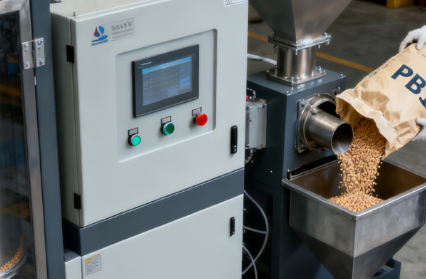
Drying is a critical pre-step for PBT processing. The standard drying protocol involves a temperature of 120°C, a dew point of ≤-20°C, 3–4 hours for new materials, and 4–6 hours for recycled materials, ensuring the moisture content drops below 0.05%. When the machine is shut down, clean the barrel with PE or PP materials to prevent carbonization and adhesion of residual PBT.
2. Adaptability Design Key Points for PBT Injection Molds
2.1 Basic Mold Parameter Design
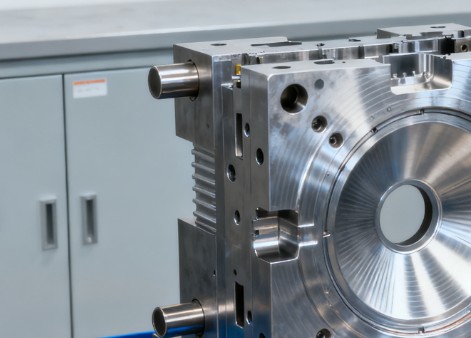
Mold steels (e.g., NAK80, S136) with both polishability and wear resistance are commonly used. The cavity surface polish grade should reach Ra0.2 or lower, and the mold clamping gap should be reserved based on the shrinkage rate—typically 1.7%–2.3% larger than the product size.
2.2 Gating and Venting System Design
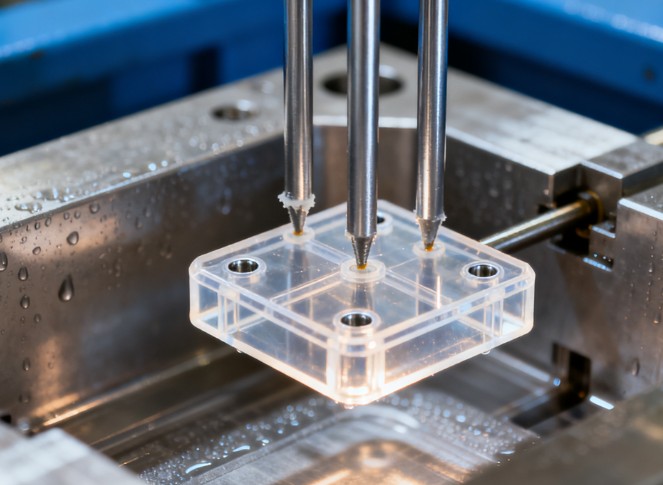
Gates should match the product size: edge gates for large parts and pin gates for small precision parts (minimum diameter of sub-gates ≥0.75mm). Circular runners are preferred, and hot runner systems are not recommended to avoid material degradation and leakage.
Venting grooves (depth: 0.02–0.04mm, width: 5–10mm) should be placed at the end of the melt flow. For complex structures, add vent inserts to prevent silver streaks or bubbles caused by trapped gas.
2.3 Cooling and Demolding System Optimization
Cooling channels (diameter: 8–12mm) should be 15–20mm away from the cavity surface, with a multi-circuit layout for uniform cooling. The demolding taper is usually 1°–2°, and gas-assisted demolding is recommended for deep-cavity or thin-walled products to reduce stress concentration.
3. Setting and Adjustment of Core Injection Process Parameters
3.1 Precise Temperature Control
Barrel temperatures are set in sections: 230–240°C (rear), 240–250°C (middle), 250–260°C (front), and 245–255°C (nozzle) for standard PBT. For glass fiber-reinforced PBT, increase each section by 5–10°C, with the overall melting temperature controlled between 225°C and 275°C.
Mold temperature is adjusted by product type: 40–60°C for non-reinforced PBT, 60–80°C for reinforced PBT (control accuracy: ±3°C). Increase to 80–100°C to resolve fiber floating.
3.2 Injection and Holding Pressure Settings
Injection speed: 120–180mm/s for standard products, 200–300mm/s for thin-walled products (reduce by 30%–50% if fiber floating occurs). Injection pressure: 60–90MPa for standard PBT, 80–110MPa for reinforced PBT.
Holding pressure uses a stepped control strategy: 40%–60% of the main injection pressure (adopt 70%→50%→30% stepped reduction for fiber floating). Back pressure: 0.3–0.5MPa (increase to 0.6–0.8MPa to improve fiber floating).
3.3 Cooling and Cycle Parameter Optimization
Cooling time is calculated as "wall thickness2 × 1.0s". Use a closed-loop drying system to reduce preprocessing time by 10%–15%, balancing production efficiency and internal stress control.
4. Typical Defects and Process Parameter Optimization Solutions
4.1 Common Defect Control Strategies
Fiber floating: Increase mold temperature to 80–100°C, reduce injection speed, raise back pressure to 0.6–0.8MPa, and use stepped holding pressure.
Warpage: Increase mold temperature to 70–80°C, extend the molding cycle by 10%–15%, or add mineral fillers to the material if needed.
Insufficient flow (thin-walled parts): Raise the material temperature to 260–270°C, increase injection pressure to 100–110MPa, and optimize gate size and venting.
4.2 Mold Scale Control
PBT contains 1%–3% oligomer residues, which easily form scale in glass fiber-reinforced grades. Control the barrel temperature below 275°C, limit material residence time to ≤30 minutes, and clean vent grooves every 2–3 hours of production.
5. Technical Trends in PBT Injection Molding
The industry now focuses on "precision control + efficient production":
Use closed-loop temperature control systems to achieve ±1°C mold temperature accuracy, combined with online moisture monitoring to optimize drying parameters.
Develop micro-vent structures and conformal cooling channels to adapt to thin-walled products (wall thickness ≤1.5mm).
Modify PBT with low-molecular-weight polyesters to improve fluidity, reducing the need for process parameter adjustments.