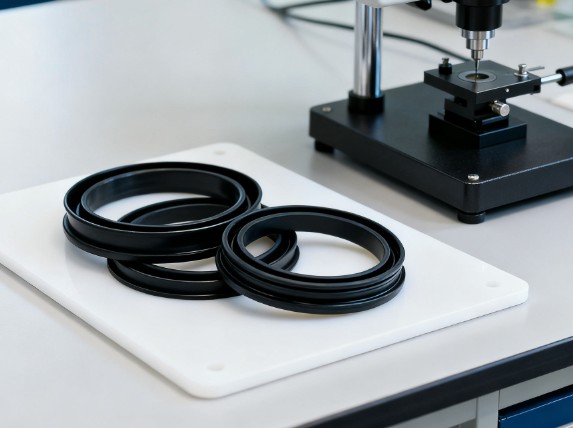
olyurethane seals (also known as PU seals or polyurethane sealing parts) are core components in the industrial sealing field. With excellent mechanical properties and working condition adaptability, they have been widely used in key industries such as automotive manufacturing, construction machinery, and new energy equipment. Combining the elasticity of rubber with the strength of engineering plastics, they perform outstandingly in dynamic sealing, medium and high-pressure sealing scenarios, becoming the preferred alternative to traditional rubber seals. Based on actual production and industry standards, this article systematically sorts out the core characteristics, production processes, application scenarios, and technical trends of polyurethane seals, providing practical references for industry practitioners.
The core competitiveness of polyurethane seals stems from their balanced mechanical properties and environmental adaptability, with the following industry-recognized key indicators:
Tensile strength up to 20-50MPa, elongation at break exceeding 350%, with mechanical strength significantly superior to ordinary rubber
Wear resistance 3-5 times that of natural rubber, Taber abrasion value controlled at 20-50mg/1000 cycles, suitable for high-frequency friction scenarios
Operating temperature range covering -40℃ to 120℃, expandable to -65℃ to 150℃ with special formulas, meeting alternating high and low-temperature working conditions
Excellent oil resistance, volume change rate ≤5% after soaking in 40℃ mineral oil for 72 hours, adapting to most industrial oil environments
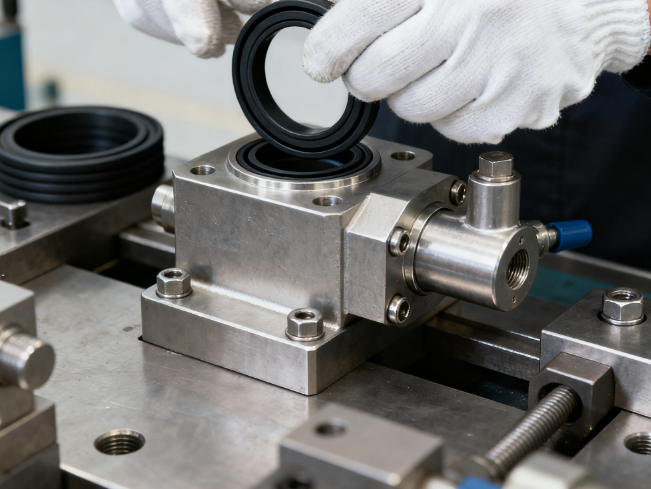
According to processing technology and molecular structure, polyurethane seals are mainly divided into two categories:
Thermoplastic Polyurethane (TPU): Good processing fluidity, suitable for mass injection molding, Shore hardness A60-95, applicable to medium and low-pressure static sealing scenarios such as hydraulic valve groups and electronic equipment sealing
Cast Polyurethane (CPU): Enhanced performance through cross-linking modification, with high pressure resistance up to 32MPa and compression set ≤15% (tested at 70℃×22h), mostly used in heavy-duty scenarios such as construction machinery hydraulic cylinders and high-pressure oil pipes
Classified by soft segment structure into polyether type and polyester type: Polyether type has excellent hydrolysis resistance, suitable for humid environments; polyester type has stronger wear resistance and outstanding oil resistance, requiring precise selection based on working conditions
The production of polyurethane seals requires strict control of parameters in each link to ensure stable performance:
Raw material pretreatment: Polyurethane particles need to be dried at 80-100℃ for 2-4 hours, with moisture content controlled below 0.05% to avoid bubbles during molding
Molding process: TPU adopts injection molding, with mold temperature 40-60℃ and melting temperature 180-220℃; CPU adopts casting molding, with vulcanization temperature 80-100℃ and curing time 16-24 hours
Post-processing: After molding, deburring and dimensional correction are required, with sealing surface roughness controlled at Ra 0.4-0.8μm to ensure assembly fit
Three core indicators need to be focused on during production:
Dimensional accuracy: Tolerance controlled at ±0.02mm, complying with ISO 3601-1 Class A standard to avoid leakage caused by assembly gaps
Mechanical properties: Sampling inspection of tensile strength and compression set, with defective rate controlled within 0.3%
Environmental adaptability: Accelerated aging test for special working conditions, tensile strength retention rate ≥85% after 72 hours of thermal aging at 120℃
New energy vehicle field: Used in battery pack cooling systems and electric drive reducers, with an average of 15-20 polyurethane seals per high-end model, tolerating -40℃ to 120℃ high and low-temperature cycles
Traditional automotive field: Adaptable to engine oil seals and transmission seals, working stably at 3000r/min rotating shaft scenarios with leakage rate ≤0.1mL/min
Applicable to hydraulic cylinders and high-pressure pipeline joints, no deformation or leakage under 31.5MPa high pressure
Can withstand more than 6 million reciprocating friction cycles, service life 3-5 times longer than traditional rubber seals
Semiconductor equipment: Used in etching and deposition processes, withstanding highly corrosive gases in high vacuum environments, sealing reliability over 99%
Energy storage equipment: A single 100MWh energy storage project requires about 5000 seals, adapting to electrolyte media and high-low temperature working conditions
Covering machine tool hydraulic systems, pneumatic components, pipeline valves and other scenarios
Select polyether or polyester products according to medium type (hydraulic oil, water-based liquids, etc.) to achieve long-term sealing
Break through performance bottlenecks through formula modification, such as adding nano-SiO? to increase PV value to 5MPa·m/s
Introduce oil-resistant modifiers to reduce oil swelling rate, meeting extreme working condition requirements
Promote low-VOC polyurethane raw materials and develop recyclable products
Energy conservation and emission reduction in production process, complying with green manufacturing policy orientation
Adopt 3D printing and digital twin technology to optimize mold design, realizing customized production of seals with complex cross-sections
Mold accuracy improved to ±0.01mm, adapting to niche and high-demand scenarios
Combine seals with sensors to develop intelligent sealing systems for real-time monitoring of sealing status
Provide data support for predictive maintenance of equipment, reducing downtime losses
The development of polyurethane seals has always iterated around working condition requirements, with performance optimization, process upgrading, and scenario expansion as the core directions. In the future, it is necessary to further strengthen the collaborative innovation of material formulas and production processes, balance performance, cost, and environmental protection requirements, and provide reliable sealing solutions for the high-quality development of industrial manufacturing.