The Eight Core Systems of Injection Molds: Design Principles and Adaptation for Test Specimen Molds
The stable operation of injection molds relies on the coordinated cooperation of eight core systems. Each system independently undertakes specific functions while interrelating to form a closed loop, directly determining plastic part molding precision, production efficiency, and mold service life. As specialized equipment for material performance testing, test specimen molds emphasize standardization, high precision, and stability in their eight-system design, serving as a typical carrier for understanding core mold principles. Combining practical production scenarios and industry technology trends, this article analyzes the key points of the eight core systems, with a focus on integrating the exclusive design requirements of test specimen molds.
1. Molding System
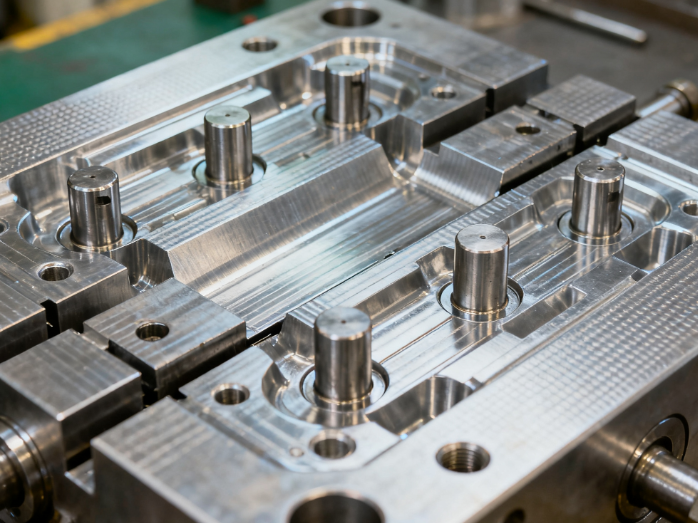
Core Function: As the mold’s core module, it forms the inner/outer surfaces and geometric structure of plastic parts through precise coordination between cavities and cores, directly determining product dimensional accuracy, surface quality, and mechanical properties.
Design Key Points: The fit clearance between cavities and cores must be controlled within 0.005-0.02mm to avoid flash or sticking. Material selection should match molding conditions, with common options including P20 pre-hardened steel and S136 mirror steel, requiring a surface roughness Ra ≤ 0.025μm.
Adaptation for Test Specimen Molds: Strictly comply with GB/T 1040.2-2006, with cavity dimensional tolerance of ±0.01mm. Polished test specimen molds use S136 steel, polishable to Ra 0.008μm for polymer material testing. Nitrided molds adopt 38CrMoAl steel with a nitrided layer thickness of 0.2-0.4mm for high-temperature and high-wear scenarios.
2. Gating System
Core Function: Connects the injection molding machine nozzle to the cavity, responsible for smoothly and uniformly delivering molten plastic to the molding area while isolating cold material and transmitting pressure.
Design Key Points: The main runner cone angle is 2°-6° with a small-end diameter of 3-6mm. Branch runners are mainly circular or trapezoidal, with a diameter of 4.8-8mm and a flow length difference ≤ 5%. Gate type is selected based on plastic part characteristics: pin gate diameter 1.5-2mm, fan gate diffusion angle 60-90°.
Adaptation for Test Specimen Molds: Single-cavity molds adopt pin gate design, with a distance of ≥5mm between the gate and the specimen end to avoid test-affecting marks. Multi-cavity molds use balanced runners with a cavity length deviation ≤0.5mm to ensure specimen performance consistency. Composite material specimen molds add fiber guide channels to prevent fiber breakage.
3. Ejection System
Core Function: After molding, mechanically ejects plastic parts from the cavity or core smoothly, ensuring no deformation or damage.
Design Key Points: Common structures include ejector pins and push plates. Ejector pins have a diameter of 2-10mm and a hardness ≥HV800 after nitriding. The push plate ejection area ratio is ≥60% for deep-cavity thin-walled parts. Ejection mechanisms must be equipped with early return devices to avoid interference with other systems.
Adaptation for Test Specimen Molds: Uses 3-5 ejector pins (diameter 2-3mm) with a fit clearance of 0.002-0.003mm for uniform force distribution. Ejector pin positions avoid key test areas of specimens to prevent stress concentration. In high-temperature conditions, ejector pins are made of Inconel 718 superalloy.
4. Cooling System
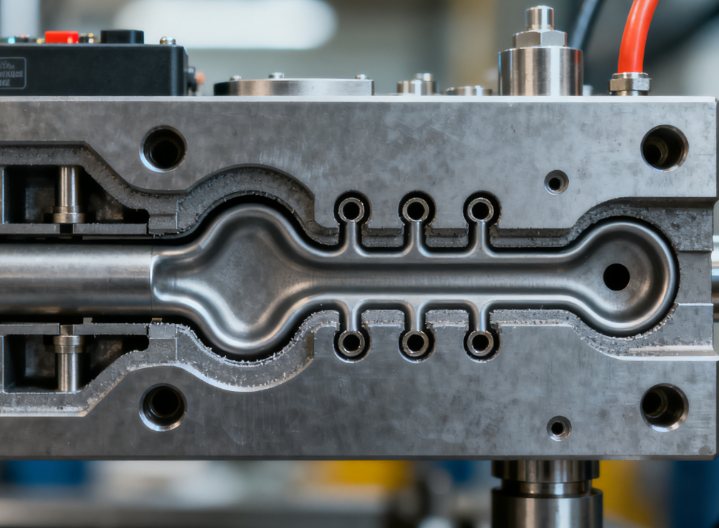
Core Function: Controls mold temperature through circulating media, shortens molding cycles, ensures uniform plastic part cooling, and reduces dimensional deformation and internal stress.
Design Key Points: Cooling channel diameter is 8-12mm, with a distance from the product contour of 1.5-2 times the channel diameter. Zone-controlled temperature design is adopted, with a temperature difference ≤2℃ on the appearance surface. Beryllium copper inserts can be used in high-heat-load areas, increasing thermal conductivity to 330W/m?K.
Adaptation for Test Specimen Molds: Polished molds have cooling channel spacing of 20-30mm and water temperature fluctuation of ±1℃. Nitrided molds have cooling channels expanded by 1-2mm with high-temperature resistant seals. 3D-printed conformal cooling channels are increasingly used in complex specimen molds, improving cooling efficiency by 40%.
5. Guiding and Positioning System
Core Function: Ensures precise alignment of moving and fixed molds during opening/closing, controls coaxiality deviation, prevents mold jamming or plastic part misalignment, and guarantees molding stability.
Design Key Points: Four sets of guide pillars and bushings are used with a fit tolerance of H7/g6 and surface roughness Ra ≤0.4μm. Large molds add central auxiliary guiding with a conical positioning angle of 5-10° and positioning accuracy of ±0.005mm.
Adaptation for Test Specimen Molds: Polished molds require guide pillar and bushing fit accuracy ≤0.005mm to avoid affecting cavity polishing precision. Nitrided molds reserve 0.1-0.2mm machining allowance for the nitrided layer. Multi-cavity specimen molds are equipped with intelligent positioning monitoring modules to provide real-time alignment deviation feedback.
6. Venting System
Core Function: Discharges air and plastic decomposition gases from the cavity, avoiding defects such as burning, bubbles, and material shortage caused by trapped gas, and ensuring smooth melt filling.
Design Key Points: Parting line vent groove depth is 0.02-0.04mm with a width of 5-10mm. Porous steel inserts can be used in deep-cavity dead corners with an air permeability ≥0.8L/(min?cm2). Vent grooves must avoid key molding surfaces.
Adaptation for Test Specimen Molds: Vent groove depth is 0.03-0.05mm, with one vent groove per 10mm of cavity length. Due to the dense nitrided layer, nitrided molds require expanded vent groove cross-sectional area. Vent structures are mandatory at the end of specimen cavities and weld line intersections, controlling porosity to <2%.
7. Side Core-Pulling System
Core Function: Molds holes, grooves, or undercut structures on the side of plastic parts, realizing core-pulling and resetting through mechanical or hydraulic drive.
Design Key Points: The angle of inclined guide pillar drive is ≤25°, and the hydraulic cylinder drive stroke accuracy is ±0.02mm. Slider surfaces are hard chrome-plated or DLC-coated with a friction coefficient ≤0.1. The angle of inclined ejectors is accurately calculated based on undercut volume and ejection stroke.
Adaptation for Test Specimen Molds: For special-shaped test specimens with grooves, hydraulic-driven sliders are used with a core-pulling speed of 5-10mm/s. The fit clearance between sliders and cavities is 0.008-0.012mm to avoid affecting specimen dimensional accuracy. Wear monitoring sensors are equipped for high-frequency use scenarios.
8. Mold Base Support System
Core Function: Supports and fixes various functional components of the mold, provides standardized installation interfaces, enhances overall mold rigidity, distributes molding pressure, and facilitates mold maintenance and replacement.
Design Key Points: Mold base material is mainly S50C carbon structural steel, with cast iron used for large molds to enhance rigidity. Template thickness is designed based on cavity size and clamping force, with deflection deformation ≤0.01mm. Standardized lifting rings and positioning pins are equipped to adapt to injection molding machine installation requirements.
Adaptation for Test Specimen Molds: Single-cavity specimen molds adopt lightweight aluminum alloy mold bases to improve mold change efficiency. Multi-cavity mold bases add reinforcing ribs to ensure stability during mass production. Modular design has become a trend, supporting quick switching between 4-cavity, 8-cavity, etc., to adapt to different testing batch requirements.
The collaborative optimization of the eight core systems is the core direction of injection mold technology development. Currently, technologies such as 3D printing, CAE simulation, and intelligent monitoring are deeply integrated into each system, driving molds toward high precision, intelligence, and green development. The standardized design concept and precise control requirements of test specimen molds provide important references for complex plastic part mold design. Mastering the design logic and adaptation principles of each system is key to entry and advancement in mold technology.