Selection Standards for Medical-Grade Steels for Plastic Molds
Medical-grade plastic molds are critical components for producing safe, reliable, and high-precision medical devices and consumables. The selection of mold steel must meet strict requirements for biocompatibility, cleanliness, corrosion resistance, polishability, dimensional stability, and wear resistance, while complying with international standards such as ISO 13485, ISO 10993, FDA, and USP Class VI. Unlike ordinary industrial molds, medical molds directly affect product safety and must be chosen through a systematic and rigorous standard.
Core Principles for Medical-Grade Mold Steel Selection
The selection follows four core principles: safety first, cleanliness priority, performance matching, and full traceability. Biocompatibility is the bottom line; steels must not release heavy metals or harmful substances and must pass biological evaluation tests. High cleanliness ensures no inclusions or pores that may cause defects on medical products. Corrosion resistance is essential to withstand repeated sterilization processes, including high-temperature steam, ethylene oxide, alcohol, and gamma irradiation. High polishability guarantees smooth, easy-to-clean surfaces that prevent bacterial residue. Dimensional stability and wear resistance support long-term mass production with consistent precision.

Key Performance Indicators for Medical-Grade Steels
Purity and CleanlinessMedical mold steels must be produced via ESR (electroslag remelting) or VAR (vacuum arc remelting) to ensure ultra-low inclusion levels. Inclusions should be rated below grade 1.5, and for implant-class products, below grade 1.0. Low gas content and fine microstructure prevent pinholes, specks, or blemishes on molded parts.
Corrosion ResistanceSteels must resist rust, oxidation, and chemical corrosion under frequent disinfection conditions. Stainless grades are strongly recommended to maintain surface integrity and avoid contamination caused by rust or degradation.
Polishing PerformanceHigh-quality polishing is essential for medical molds. Standard requirements reach Ra ≤ 0.02 μm for mirror surfaces used in syringes, catheter components, and optical parts. A flawless surface ensures easy demolding and cleanability.
Hardness and Wear ResistanceAppropriate hardness ensures dimensional stability and service life. Typical hardness ranges from HRC 48 to 54. For high-volume production or filled resins, higher hardness and surface strengthening treatments are required.
Biological Safety and CertificationAll materials must comply with ISO 10993 and USP Class VI, with complete material reports, batch traceability, and quality certificates required for regulatory approval.
Commonly Used Medical-Grade Mold Steels
S136 / S136HThe most widely used stainless steel for medical molds. It offers excellent corrosion resistance, superior polishability, and good stability. Suitable for syringes, pipettes, disposable supplies, and transparent components.
17-4PHA precipitation-hardening stainless steel with high strength, excellent cleanliness, and improved corrosion resistance. Used for high-end devices, implant-related products, and precision structural parts.
SKD61 / 1.2344Heat-resistant tool steels used for high-temperature resins such as PEEK, PSU, and PPSU. They provide excellent thermal stability and wear resistance for engineering medical components.
NAK80 / 718HPre-hardened steels for non-implant, medium-precision medical parts such as housings, connectors, and non-critical structural components.
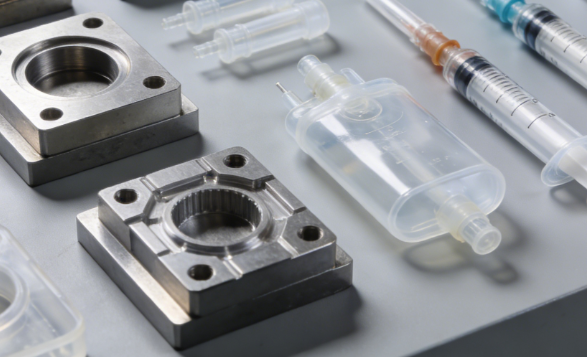
Material Verification and Surface Treatment
After incoming inspection, materials must undergo hardness testing, spectral analysis, and corrosion testing. Surface treatments include mirror polishing, passivation, nitriding, and DLC coating to improve wear resistance, demolding, and cleanliness. All treatments must be free of toxic or heavy-metal components.
Summary
The selection of medical-grade mold steel is a comprehensive decision based on safety, cleanliness, corrosion resistance, polishability, and regulatory compliance. Choosing the right steel ensures stable production, long mold life, and full compliance with medical industry requirements. Proper material selection directly determines the quality, safety, and market approval of final medical products.